Healthy Home
- Also in
- Strength + Movement
Home Office Comfort Guide
A workspace that supports your back, your eyes and your focus.
- home office
- ergonomics
- focus
By Simone · 15 August 2026 · Updated 15 August 2026 · 8 min read
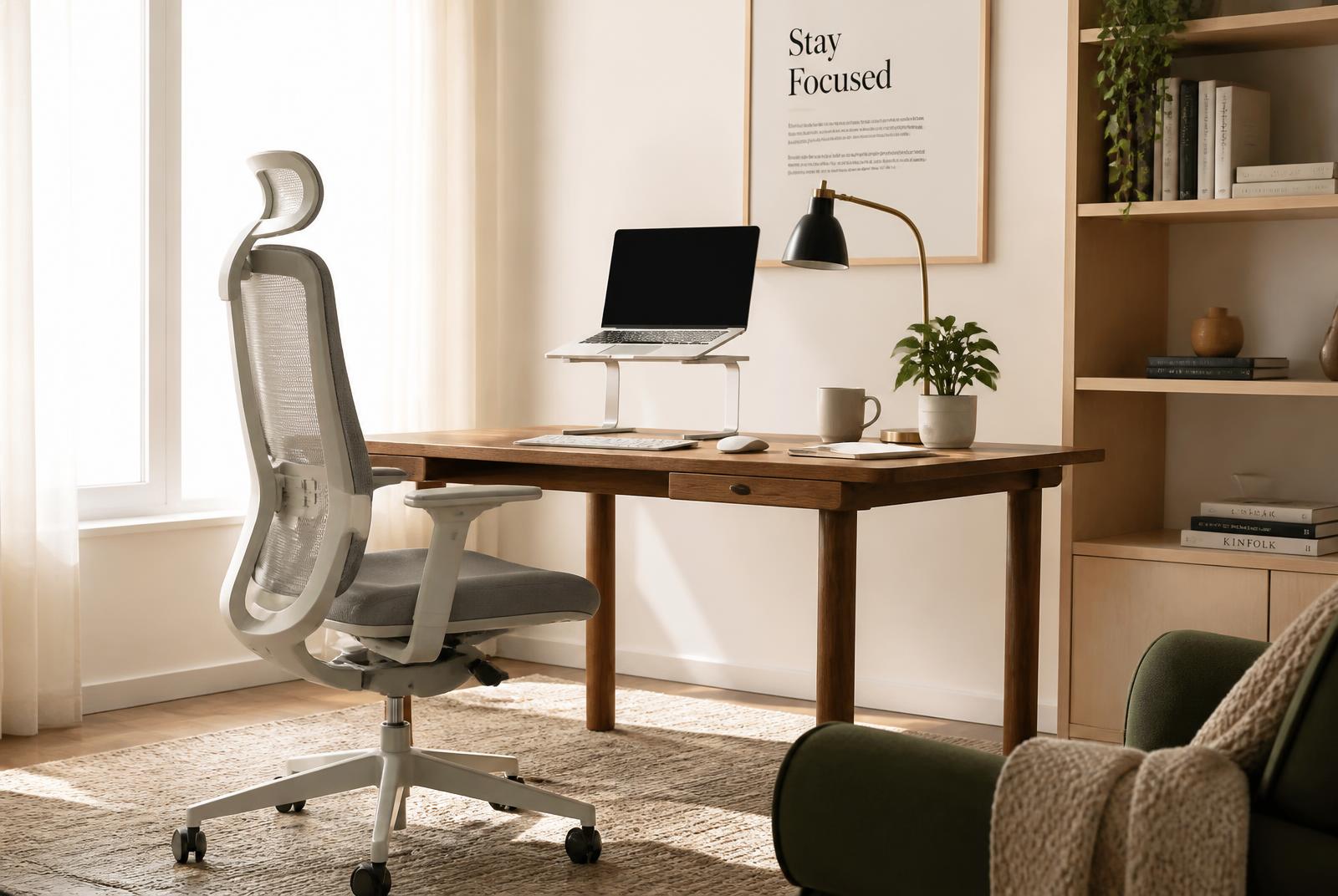
Most home offices happen by accident — a laptop on a kitchen table, a chair borrowed from the dining room, a phone propped against a stack of books. It works, until one afternoon you notice your shoulders are somewhere near your ears and you have been squinting since lunch.
You do not need a dedicated room or an expensive fit-out. You need a handful of deliberate changes, most of which cost nothing, and a setup that lets you finish the day feeling like yourself.
Start with the screen
If you change one thing, change this. Raise the laptop so the top of the screen sits roughly level with your eyes, about an arm's length away. A laptop stand does it, so does a shoebox or a stack of hardbacks.
The moment you raise the screen you can no longer type comfortably, which is the point — add a separate keyboard and mouse. Screen up, hands down. That single split solves most of the neck and upper-back complaints people blame on "just getting older".
If you use two screens, put the one you look at most directly in front of you, not off to the side. Your neck should not have to rotate all day to do your job.
Sit like you mean it
The rough shape to aim for: feet flat on the floor, hips level with or slightly above your knees, forearms roughly parallel to the desk, shoulders relaxed rather than shrugged.
A good chair earns its money over a year of eight-hour days, but you can get a long way with what you own. A cushion raises you to the right desk height. A rolled towel behind your lower back restores the natural curve your spine wants. A box or a thick book under your feet stops your legs dangling if the chair is too tall.
If your desk is too high — and most dining tables are — raise yourself and support your feet, rather than reaching up all day.
Light from the side
Daylight is the best desk lamp you will ever own, but only from the right direction. A window behind you throws glare onto the screen; a window directly in front turns your face into a silhouette and makes your eyes work overtime. Set the desk so light comes from the side.
Add a warm desk lamp for late afternoons so the room does not fall into gloom around you while the screen stays bright — that contrast is what makes eyes ache. And keep the screen brightness roughly matched to the room, not blazing against a dark wall.
The old rule still holds: every twenty minutes, look at something twenty feet away for twenty seconds. It costs nothing and it works.
Build in movement
The best posture is always the next one. No chair, however good, is designed to be sat in for nine hours straight.
Stand and move for a few minutes every hour. Take calls on your feet or walking. Refill the water glass one room away on purpose. If you can, alternate between sitting and standing across the day rather than committing to either — variety beats perfection.
Two small resets that help more than they should: roll the shoulders back and down a few times, and open the chest by clasping your hands behind you for thirty seconds. Do them at the top of each hour and your upper back will thank you by five o'clock.
Sound, air and the small annoyances
Comfort is not only physical. A pair of headphones that mute the household, a window cracked for fresh air, a plant within eyeline and a cable tidy that stops the desk looking like a nest — these are the things that decide whether the room feels calm or chaotic.
Keep the surface mostly clear. Whatever you need daily stays out; everything else goes into a drawer or a box. A clear desk is not about tidiness for its own sake, it is about not spending the first ten minutes of every task moving things.
Close the day properly
If you work where you live, the hardest part is stopping. Give yourself a small ritual: shut the laptop, tidy the desk, turn off the lamp. If the office shares a room with the rest of your life, put the laptop in a drawer or a bag so it is out of sight.
A short walk after the last task does the job of a commute — it tells your body the working day is over. That transition matters as much as any chair.
Found this useful? Save it for later.
Save to Pinterest